GRC: Turning Technology Decisions Into Organizational Resilience
By F. Jay Hall and Stephan Pochet | October 9, 2026
Before approving new technology, leaders need clear ownership, practical safeguards, and a decision process they can explain and defend.
Governance, risk, and compliance (GRC) gives organizations a practical way to connect technology decisions with accountability, evidence, and ongoing oversight. Organizational resilience is the ability to withstand disruption, adapt, and continue delivering on the mission.
Download the one-page infographic (PDF)
The Risk Behind Every Technology Decision
A technology decision can lead to:
- Financial loss
- Regulatory penalties
- Operational disruption
- Harm to the public
- Damage to the organization’s reputation
GRC helps leaders identify and manage these risks before they become expensive or difficult to reverse.
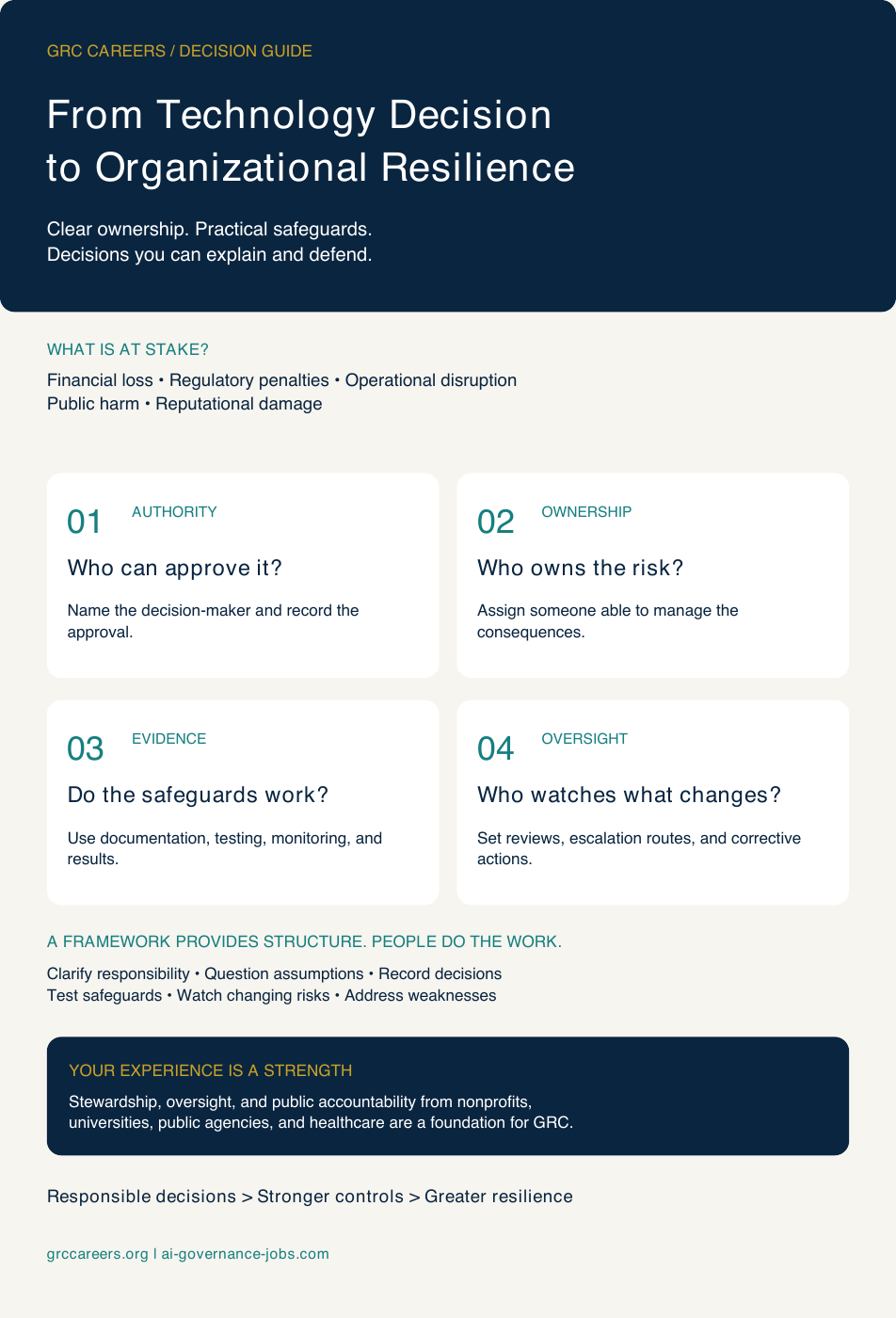
Four Questions to Ask Before Approval
1. Who has the authority to approve it?
Identify the person or group responsible for approving the technology and recording the decision.
2. Who owns the risk?
Assign responsibility to someone who can manage the technology’s potential consequences.
3. What evidence shows the safeguards work?
Approval should be supported by documentation, testing, monitoring, and results that show whether the safeguards are effective.
4. How will the technology be overseen?
Decide how performance and risk will be reviewed after approval. Be clear about who will monitor changes, address problems, and raise concerns when safeguards stop working.
For AI systems, use an AI risk assessment to examine potential consequences and an AI risk register to keep ownership and actions visible.
GRC Supports Everyday Decisions
These questions matter before an audit. They affect how organizations spend money, protect the people they serve, and decide which opportunities are worth pursuing.
GRC helps organizations determine:
- How to use resources responsibly
- How to protect the people they serve
- Which opportunities they can pursue
- Which risks they are willing to accept
- When they need to act to prevent harm
A Framework Provides Structure
A framework can organize the work, but it does not do the work for you.
GRC is useful when people use it to:
- Clarify who is responsible
- Question assumptions
- Record decisions
- Test safeguards
- Watch for changing risks
- Address weaknesses before they cause problems
For further reading, NIST provides the Cybersecurity Framework for managing cybersecurity risk and the AI Risk Management Framework for AI risk. Our NIST AI RMF guide connects the latter to governance practice.
Mission-Driven Professionals Already Have a Strong Foundation
Professionals from nonprofits, universities, public agencies, healthcare organizations, and other mission-driven institutions often bring relevant experience to GRC.
Their work already involves:
- Stewardship
- Oversight
- Public accountability
- Responsible use of resources
- Balancing opportunity with responsibility
That experience provides a solid foundation for applying governance, risk, and compliance practices to technology decisions.
Explore how nonprofit, legal, and compliance experience transfers to AI governance and our career guides.
Your Experience Is a Strength
Your experience with responsible decision-making is directly relevant to GRC.
GRC gives you a practical way to apply that experience to technology.
It helps turn:
Responsible decisions → Stronger controls → Greater resilience
From Responsible Decisions to Resilience
Technology decisions should not be based on speed or optimism alone.
They require:
- Clear authority
- Defined accountability
- Reliable evidence
- Documented reasoning
- Ongoing oversight
That is how GRC turns responsible decision-making into organizational resilience.
Frequently Asked Questions
What does GRC mean in technology decisions?
GRC means governance, risk, and compliance. It connects decision-making authority, responsibility for risk, evidence of effective safeguards, and oversight after a technology is approved.
What should leaders ask before approving new technology?
Ask who can approve it, who owns the risk, what evidence shows the safeguards work, and how the technology will be overseen after approval.
How does GRC support organizational resilience?
GRC helps organizations identify potential harm, assign responsibility, test safeguards, and respond when risks change. These practices support continuity and adaptation, but do not eliminate all risk.
Does adopting a framework mean the work is complete?
No. A framework organizes the work. People still need to record decisions, test controls, monitor results, question assumptions, and address weaknesses.
Can nonprofit experience transfer to technology GRC?
Yes. Stewardship, oversight, public accountability, and responsible resource use provide a relevant foundation. Professionals can build on it by learning technology risks, control testing, and the frameworks relevant to their roles.
Originally published on AI Governance Jobs. Explore GRC Careers and Beyond Résumé.
Across our network: Read this article on ExecSearches, Nonprofit-Jobs.org, or GRC Careers Essays.